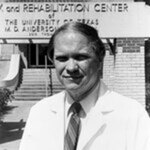
Chapter 01: An Officer, an Attorney, and a Physician
Files
Loading...
Description
After an introduction by the interviewer (Allison Saenz), Dr. Albert Gunn begins his interview by discussing his early life, education, and military career. After a career as a military attorney, Dr. Gunn decided to transition to healthcare, where he attended medical school in Ireland, eventually interning in New York. Following medical school, he worked at the American Medical Association in Suffolk County. While in New York, Dr. Gunn befriended Dr. Vincent F. Guinee. After Dr. R. Lee Clark recruited him to MD Anderson, Dr. Guinee created the rehabilitation program and offered the position of medical director to Dr. Gunn.
Identifier
GunnAE_20240627_C01
Publication Date
7-27-2024
City
Houston, Texas
Interview Session
Topic Covered
Professional Path; Personal Background; Professional Path; Military Experience; Joining MD Anderson; MD Anderson Culture
Creative Commons License

This work is licensed under a Creative Commons Attribution-Noncommercial-No Derivative Works 3.0 License.
Disciplines
History of Science, Technology, and Medicine | Oncology | Oral History
Transcript
Allison Sáenz, PhD :
Perfect, okay, I just press [okay?]—
Albert E. Gunn, MD:
Hi, Al— Allison Sáenz, PhD Hi, good to see you and be with you today. I’m excited to, like I said, hear more about you and your story. I’ve already researched quite a bit based off the scrapbooks that were passed down to me and—
Albert E. Gunn, MD:
Yeah, I’m sorry, there was so much extraneous material in them.
Allison Sáenz, PhD :
No, it was really interesting. As a historian, I love being invested in people’s stories, so. I will start off by reading a quick, formal introduction, and then we’ll jump right into the questions if that’s cool with you?
Albert E. Gunn, MD:
Fine.
Allison Sáenz, PhD :
Perfect, okay, so good afternoon. Today is Thursday, June 27, 2024, and it is approximately 1:29 p.m. This is Allison Sáenz interviewing Dr. Albert E. Gunn for an oral history project run by the Historical Resources Center at MD Anderson Cancer Center in Houston, Texas. And this interview is being held virtually over Zoom. Dr. Gunn spent several decades at MD Anderson. He was hired in 1975 as the director for the rehabilitation center and also served subsequent roles at UT Medical School, including as a professor and dean of admissions. Thank you for sharing your historical memories with us, Dr. Gunn. As I’ve mentioned before, I have a few questions to guide the interview that cover various themes and events in relation to your time and years at the institution. But ultimately, it’s a conversation, so please feel free to take the answers anywhere you see fit. So why don’t we get started?
Albert E. Gunn, MD:
Right.
Allison Sáenz, PhD :
Perfect, okay, so the first question is pretty broad, about the earlier years of your life, can you provide some insight into your background? Where did you grow up and what was it like, and are there any particular memories that stand out from those early years of your life?
Albert E. Gunn, MD:
Well, I was born in Doctors Convalescent Home [sic] on Main Street in Port Washington, New York, and I grew up in Port Washington. I went to Manhasset Bay School, which was a progressive school, with the faculty drawn from the—oh, the Bank Street School and Columbia University’s School of Education. And then as a contrast, my father decided that I needed a more structured environment, and in the eighth grade, I was transferred to La Salle Military Academy, which was a different atmosphere altogether, and I went through La Salle Military Academy. We had a summer home in East Marion, which I dearly love, which is at the end of Long Island, and later came into play when I became a employee of the Suffolk County Department of Health. I grew up in Port Washington as I said, and went to LaSalle, then I went to Fordham College in the Bronx, got a scholarship to Fordham Law School. Am I going into too much detail?
Allison Sáenz, PhD :
No, this is perfect, and even if you get ahead of other questions I have, it’s all perfect.
Albert E. Gunn, MD:
And so I completed that, and at those days, we had something called the draft, which fortunately is gone, and so I went into the air force as a lieutenant—a second lieutenant. And when I was admitted to the bar after passing the bar examination, I became first lieutenant, which was quite a difference. You get treated very differently from the two grades oddly enough. And I was initially assigned to Craig Air Force Base in Alabama, 3615th Pilot Training Wing. And then after my importuning the air force for a foreign assignment, I was transferred to Spain, Morón de la Frontera, Spain, which is near Seville, and that was the 3973rd Combat Support Group, Strategic Air Command, so that was a different kettle of fish, very spit and polish and so on. And so there, I engaged in military justice duties with court-martials, and I prosecuted murder and other major crimes that fell to the American justice system because of the status of forces agreement. And I began to look at life in a different vein, thinking about what my role should be and what I wanted to be, and decided I was going to be a doctor. And so it seemed to be an impossible task because I never did premed, I was a history major, and so I decided to apply to a number of different schools in Europe. And providentially, I noticed that Ireland had medical schools, their language of instruction was English, and premed was the first year. And you didn’t have a separate process to go to premed, and then be selected again, so that seemed to be an advantage. I applied and was accepted, and off I went to medical school, and I completed the premed as part of the medical school and graduated, returned to the United States. I was a interned at Montefiore Hospital in the Bronx. (Spanish). I was—
Allison Sáenz, PhD :
(Spanish)
Albert E. Gunn, MD:
(Spanish) But anyway, I came back to New York, was an intern in Montefiore Hospital and Medical Center, then an internal medicine resident at Roosevelt Hospital in Midtown, then I went to the University of Rochester for neurology. I was going to be double-boarded in internal medicine and neurology but ran out of money. My G.I. Bill ran out, and so I went to work for the American Medical Association in Washington as assistant director of governmental relations, which they assigned me all the scientific end of their relationship. So I had the CDC, and providentially also, the NIH, the NCI, all of the scientific areas of the medical—American Medical Association had relations. So it opened my horizons as to a lot of different places, and one of them was MD Anderson because I came in an assignment to Dallas. And one of the side issues, they were going on side trips they were doing, was to see the marvelous MD Anderson Hospital in Houston. That’s first I heard of it and the first I got familiar with it, and the other delegates who went down and came back were very impressed with it. And so I left the American Medical Association to become the medical director of geriatric services for the Suffolk County Department of Health. As I said, I was a summer resident of East Marion in the end of Long Island, which was paradise, and so I was only too happy to go back to Suffolk County and see if I could reduplicate my enjoyment of my youth in the eastern part of Long Island. So anyway, I was assigned [wider?] duties, including screening programs, and so. I—though I was, for budget reasons, titled a medical director of geriatric services, I was really the deputy department chairman or division chairman for adult health. And I had clinics that were under me and variety of other things. A good friend of mine was Dr. Vincent F. Guinee, and he was the assistant commissioner of health in New York City. And Dr. Guinee was a very capable person, and he rose to, I think, the medical director for Brooklyn as assistant commissioner. And he was wooed by MD Anderson to come down and set up an epidemiology program, and so he went. And, again, MD Anderson came to my attention, and I was impressed with this—his very favorable impression of MD and of his impression of Dr. Clark who is the president of MD Anderson. That he talked to me about him, what a wonderful man he—what an ingenious and brilliant man he was and how much he had done for cancer therapy. So Dr. Guinee left, and when he got down, already put my name in as a suggestion to MD Anderson for some role, and I got contacted by [Pat Leon?]. Now, Dr. R. Lee Clark had started MD Anderson, and he was noticing that it had grown exponentially. It was a much bigger place than the little, informal, oh, institution that it had been where everybody—and they could run it informally just on a handshake and a business. So Dr. Clark was anxious to put it on a stronger organizational footing, and he hired a man by the name of Pat Leon, who worked for the [Sikorsky?] Company, to organize MD Anderson into a more rational type of institution. And one of the problems they were having is they had gotten the United States government to rehabilitate the old Southern Pacific Hospital. Southern Pacific Company had a series of hospitals for its railroad workers across the Southwestern United States. I think there was one in Phoenix and probably in California, I don’t know, but there was one in Houston that had no longer—was no longer used. And a plan was put forward to redecorate, redo it, rebuild it as it were, and turn it into a rehabilitation center. And the federal government paid for that, and it was a beautiful building. I think there’s a picture in the archives of the library of it.
Allison Sáenz, PhD :
There is, yes, I’ve seen it too—yeah.
Albert E. Gunn, MD:
And they spared no expense in turning it into a first-rate rehab center. And they had hired some people for it, but they had an open position for a medical director and—
Allison Sáenz, PhD :
[Were you a founding?] director?
Albert E. Gunn, MD:
Medical director.
Allison Sáenz, PhD :
Okay, mm-hmm, great.
Albert E. Gunn, MD:
And I was also—yeah, well, we’ll get to the rest of the story. So Pat Leon asked me if I’d be interested in meeting with Dr. Clark, and I said certainly after the many things I’d heard about him from Dr. Guinee and others. And so it was arranged that I would meet them in Albany where Dr. Clark was attending a meeting with Pat Leon and others, and I flew to Albany from Hauppauge in Suffolk County and met Dr. Clark and met Pat Leon. And the job they were talking about was not one that I was that interested in, and so we parted in good company, and I was pleased to meet them, and I returned home. And then a little later, the phone rang, and I was told a phone call from Dr. Clark, and he said, “How would you like to be medical director of the rehab center?” and I said, “Well, that’s [something new that?] we were discussing,” and he says, “I know.” He said, “Now, you catch such and such flight in the Eastern Airlines at LaGuardia Airport.” He knew this flight because his daughter lived close by. “And we’ll pick you up at the airport and show you around,” and that’s what happened. I got on the plane with my wife and down we came in Eastern Airlines, a favorable memory. And I met—stayed at the Anderson Mayfair, which was the hotel that MD Anderson had, and it was also Dr. Clark’s residence, he lived in a penthouse there. And I was toured around and shown the place and offered the job.
Recommended Citation
Gunn, Albert E. JD, MD and Sáenz, Allison PhD, "Chapter 01: An Officer, an Attorney, and a Physician" (2024). Interview Chapters. 1606.
https://openworks.mdanderson.org/mchv_interviewchapters/1606
Conditions Governing Access
Open
Accessibility Statement
This item was created prior to May 2026. It is preserved for research, reference, or historical recordkeeping. Following WCAG 2.1, the library may provide accessible versions of archival materials upon request. For accommodation requests please submit an accessibility request form.