Chapter 03: Work in the Cancer Patient
Files
Loading...
Description
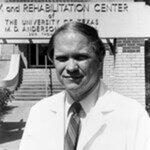
Dr. Gunn talks about his work with people with disabilities, especially when it impacts quality of life following cancer treatment. He was a delegate at a White House Conference on Handicapped Individuals, published on rehabilitation for patients, and served on the Texas Rehabilitation Commission. Overall, he saw his work helping rehabilitate as a positive aspect of his career.
Identifier
GunnAE_20240627_C03
Publication Date
7-27-2024
City
Houston, Texas
Interview Session
Topic Covered
The Clinical Provider; Character, Values, Beliefs, Talents; Professional Values, Ethics, Purpose; Offering Care, Compassion, Help; Patients; Patients, Treatment, Survivors
Creative Commons License

This work is licensed under a Creative Commons Attribution-Noncommercial-No Derivative Works 3.0 License.
Disciplines
History of Science, Technology, and Medicine | Oncology | Oral History
Transcript
Allison Sáenz, PhD: No, it’s great. Well, you’re—it’s funny, always—interviewees are always different, and some will take one question and run with it, which you have, and I’m grateful for all of those insights. You’ve basically gone through my first four questions, so it’s perfect. If you want to keep going, we totally can, but, yeah, really, your—I think your insights about the intersection of the different hats that you got to wear at MD Anderson is really important. So your work as a professor and trying to integrate MD—well, the rehabilitation center with the larger institution, if you want to speak more about that or—? Yeah.
Albert E. Gunn, MD:
Well, if you’d like, I’ll talk a little about work in the cancer patient.
Allison Sáenz, PhD :
Perfect, please go ahead.
Albert E. Gunn, MD:
One of my particular interests, Dr. Clark had noticed an announcement that—by President Carter that they were going to hold a conference on handicapped people, a White House Conference on Handicapped people. And he said to me—Dr. Clark gave out assignments, he said, “I want you to get involved with that, get interested in it.” So I wrote a letter to the executive director of it, Dr. Viscardi—I’m sorry, the name is ring—doesn’t ring a bell at the moment, but anyway, telling him that I felt that the cancer patient should be considered in their work of handicapped individuals, and I thought they should pay attention to it. And the next thing is I got a letter from the doctor appointing me as a delegate at large to the White House Conference on Handicapped Individuals. Well, Dr. Clark was very pleased with it, and that’s what he wanted to see. And so I went up as a delegate into Washington to the White House Conference on Handicapped Individuals. And while I was there, we discussed the hidden handicap, and this is—you’re looking a little surprised, I think, at this. The hidden handicap, what is it? Well, when a person is employed by a company or something, they go for cancer treatment, they’re treated, they’re cured, five-year survival rate. They come back, but there’s a limitation on them at their work. They don’t—not fully accepted back, or at least that’s the way it was, and that was the hidden handicap. Though you were cured, that you were treated, you were taken care of, you still were not given your full credit by your employers because they said, “Well, he’s got cancer or he had cancer, and he won’t be with us all that much longer,” and so on, and that was the hidden handicap. And this caught the imagination of a reporter for Texas Monthly. I forgot his name, but his article’s in the scrapbook, I think, and he wrote an article on it about the hidden handicap. He himself had had cancer, and he had experienced some of this, and so he was in a perfect position to write a very good article. And it caused a stir even at the NCI when this article was released among the rehab people there. And also, it’s sort of—Dr. van Eys, who was the chairman of pediatrics, asked me to write a chapter in his book about the hidden handicap and give a presentation on it. And it’s something that we wanted to develop as work in the cancer patient, how can we help the cancer patient reintegrate back into work? This is important in their life. And so a friend of mine and I—Mike Batten was a friend of mine for many years, and he had been at the National Council on Aging and the Kirschner Associates, and he had worked on a system for the de Havilland Aircraft Company of reintegrating handicapped people into the workforce. It was called the [Gullhamp?] system, I won’t explain all of what it is, but anyway, we sat down together and wrote a proposal to employ this for cancer patients with that. And the idea being we’re going to show that they’re just as capable of work, on being an asset to the companies as anybody else. And the Gullhamp was a scoring system you could evaluate the patient on and rate them and—as what their capabilities were through a variety of systems and things that would be important to employers. And we put this proposal together, and it was approved at MD Anderson as a project program. When Dr. Clark heard about it, he was very pleased, he says, “You and your friend wrote this, did you?” I said, “Yeah.” He said, “Well, go for it then.” Well, we brought it to Washington, and they—the NCI wasn’t ready for it to be honest, but it was approved at MD Anderson, and it served as a blueprint for later work that we tried to undertake with the work. And now, one of the things that took place was I was appointed a consultant to the Texas Rehabilitation Commission, and they delegated to MD Anderson and to me, the authority to evaluate patients for rehabilitation funding. They sent their representative with me and she—or she, yes, she identified the cases where there was a potential for rehabilitation, potential in funding, and I reviewed the case, and I could approve it. And this was a big advantage for MD Anderson, and, in fact, the people at the rehab commission, very supportive of MD Anderson as a result of it, because we had a good relationship with them as a result of it. So the tangible interest it was—of getting involved with work in the cancer patient was we got this process approved to [facilitate?] MD Anderson patients. So that was something that was tangible of it, and also, we kept after the thing in publications. I know in my book, I have a chapter of things related to the work in the cancer patient, and so on. So that was one of the things that did come out of the rehab center that I thought was of a positive development.
Allison Sáenz, PhD :
Right.
Albert E. Gunn, MD:
Go ahead.
Allison Sáenz, PhD :
Oh, no, I was just going to—it seems that you had a really close relationship with R. Lee Clark, right, when you arrived and throughout your time. Did that also exist through other presidencies or was it mostly, yeah, just with him?
Recommended Citation
Gunn, Albert E. JD, MD and Sáenz, Allison PhD, "Chapter 03: Work in the Cancer Patient" (2024). Interview Chapters. 1608.
https://openworks.mdanderson.org/mchv_interviewchapters/1608
Conditions Governing Access
Open
Accessibility Statement
This item was created prior to May 2026. It is preserved for research, reference, or historical recordkeeping. Following WCAG 2.1, the library may provide accessible versions of archival materials upon request. For accommodation requests please submit an accessibility request form.