CATALYST Summer Training Programs
CATALYST is an umbrella program comprised of 18 unique summer academic research programs at MD Anderson developed specifically for students interested in an advanced degree and/or a career in cancer research. We encourage you to visit the Programs page to view all of the wonderful opportunities, organized by educational stage, offered at MD Anderson each summer.
-
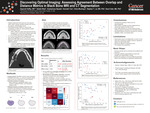
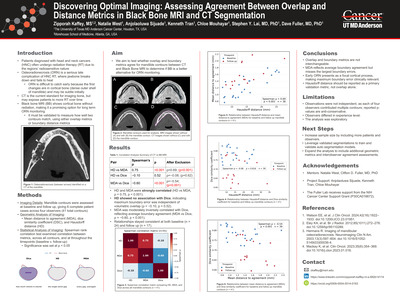
Discovering Optimal Imaging: Assessing Agreement Between Overlap and Distance Metrics in Black Bone MRI and CT Segmentation
Zipporah Kaffey, Natalie West, Anjolaoluwa Sijuade, Kenneth Tran, Chloe Mouhayar, Stephen Y. Lai, and Clifton D. Fuller
This poster explores the overlap and boundary metrics used to validate and compare Black Bone MRI (BB) contours to those of CT. The aim is to explore whether those metrics agree or not and to explore BB as an alternative to CT in monitoring head and neck cancer patients post-radiation therapy for adverse effects such as ORN.
-
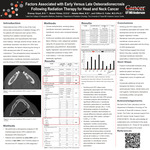
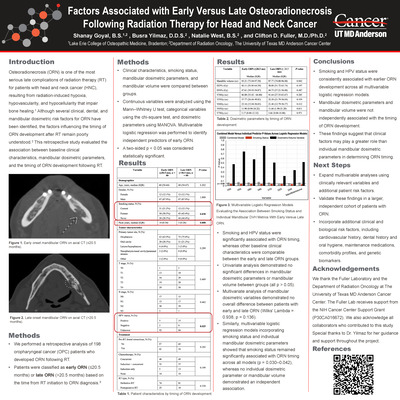
Factors Associated with Early Versus Late Osteoradionecrosis Following Radiation Therapy for Head and Neck Cancer
Shanay Goyal, Busra Yilmaz, Natalie West, and Clifton D. Fuller
-
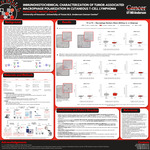
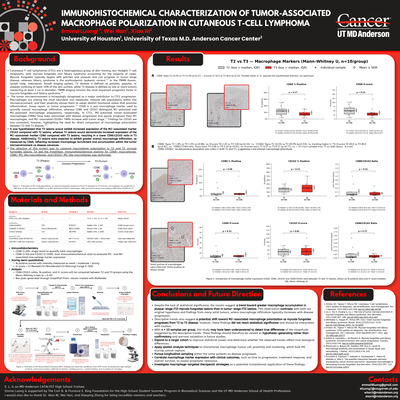
Immunohistochemical Characterization of Tumor-Associated Macrophage Polarization in Cutaneous T-Cell Lymphoma
Emma Luong, Wei Han, and Xiao Ni
-
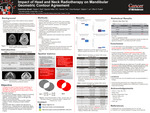
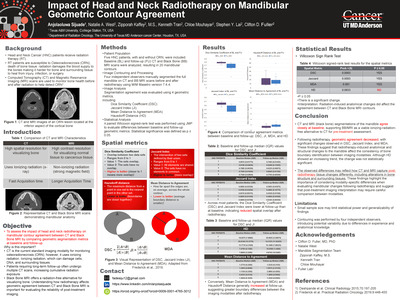
Impact of Head and Neck Radiotherapy on Mandibular Geometric Contour Agreement
Anjolaoluwa Fadekemi Sijuade, Natalie A. West, Clifton Dave Fuller, Zipporah Kaffey, Kenneth Tran, and Chloe Mouhayar
To assess the impact of head and neck radiotherapy on mandibular contour agreement between CT and Black Bone MRI by comparing geometric segmentation metrics at baseline and follow-up.
-
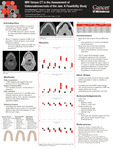
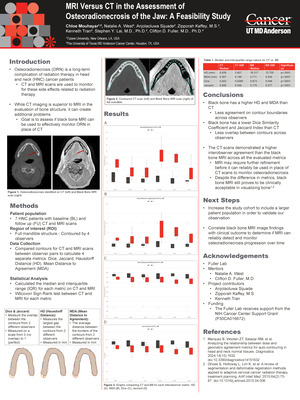
MRI Versus CT in the Assessment of Osteoradionecrosis of the Jaw: A Feasibility Study
Chloe Marie Mouhayar, Natalie West, Anjolaoluwa Sijuade, Zipporah Kaffey, Kenneth Tran, and Stephen Lai
The interobserver agreement of CT scans and black bone MRI scans were compared by calculating the dice similarity coefficient, jaccard index, Hausdorff distance, and mean distance to agreement of each observer contour pair in order to assess how black bone MRI compares to CT in monitoring osteoradionecrosis. Value and Impact CT imaging is currently the golden standard in evaluating bone structure and therefore monitoring osteoradionecrosis after radiation therapy, but it can create additional complications. The purpose of this study was to determine if black bone MRI is clinically acceptable in monitoring osteoradionecrosis in place of CT.
-
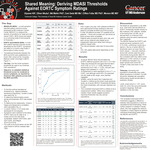
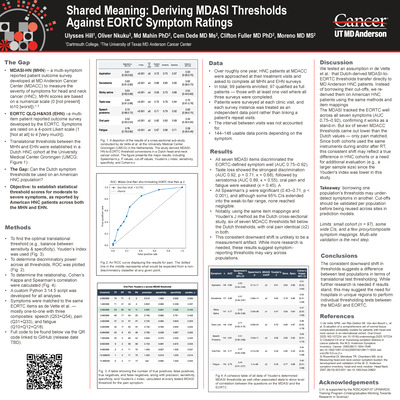
Shared Meaning: Deriving MDASI Thresholds Against EORTC Symptom Ratings
Ulysses Joseph Hill; Oliver Nkuku BS; MD Mahin PhD; Cem Dede MS, MD; Clifton D. Fuller MD, PhD; and Amy Moreno MD
The gap between the MDASI (0-10 severity scoring) used at MD Anderson Cancer Center (MDACC) and the EORTC(1-4 presence scoring) used in the CITOR framework is easily apparent. In 2025, a conversion between the two was done as part of a larger study in a population of head and neck cancer patients at the University Medical Center Groningen (UMCG). The study compared several symptoms on the EORTC QLQ-C30/H&N35 (EHN) with the 0-10 score for the symptom given by a patient on the MDASI Head and Neck (MHN). The question remained: would these results hold in an MDACC population? In this project, 97 MDACC patients were given both the MHN and EHN, and the results were compared to determine a threshold for conversion between the two tests. Overall, a clear downward shift was discovered, indicating the need for more research due to the overall lower Youden’s Js or a true difference between the populations' thresholds. Value and Impact Borrowing one population's thresholds may under-detect symptoms in another. Cut-offs should be validated per population before being reused across sites in prediction models.
-
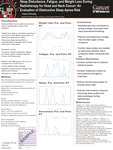
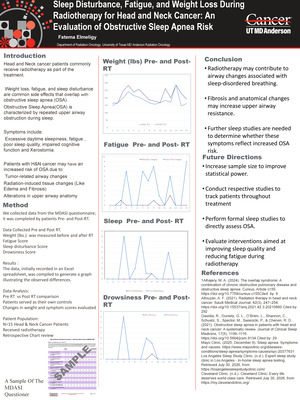
Sleep Disturbance, Fatigue, and Weight Loss During Radiotherapy for Head and Neck Cancer: An Evaluation of Obstructive Sleep Apnea Risk
Fatema M. Elmeligy, Busra Yilmaz, Sophie T. Melancon, and Clifton D. Fuller
-
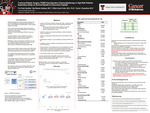
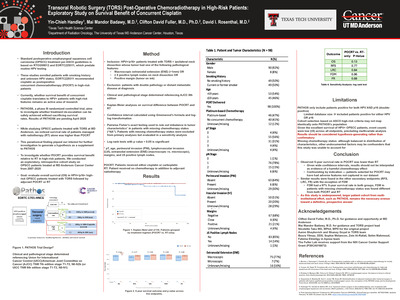
Transoral Robotic Surgery (TORS) Post-Operative Chemoradiotherapy in High-Risk Patients: Exploratory Study on Survival Benefit of Concurrent Cisplatin
Yin-Chieh Handley, Clifton D. Fuller, Mai Mandor Badawy, and David I. Rosenthal
Preliminary evaluation of survival and recurrence benefits of adjuvant radiotherapy with and without cisplatin.
-
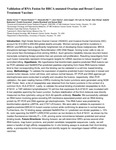
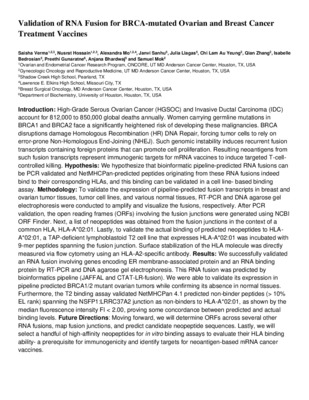
Validation of RNA Fusion for BRCA-mutated Ovarian and Breast Cancer Treatment Vaccines
Saisha Verma, Nusrat Hossain, Alexandra Mo, Janvi Sanhu, Julia Llagas, Chi Lam A. Yeung, Qian Zhang, Isabel Bedrosian, Preethi H. Gunaratne, Anjana Bhardwaj, and Samuel C. Mok