Chapter 01: A Track to Nursing Education
Files
Loading...
Identifier
HilkemeyerR_01_20000523_C01
Publication Date
5-23-2000
Publisher
The Historical Resources Center, Research Medical Library, The University of Texas Cancer Center
City
Houston, Texas
Topic Covered
Professional Path; Character, Values, Beliefs, Talents; Personal Background; Professional Path; Evolution of Career; Influences from People and Life Experiences; Experiences Related to Gender, Race, Ethnicity; Formative Experiences; The Patient
Creative Commons License

This work is licensed under a Creative Commons Attribution-Noncommercial-No Derivative Works 3.0 License.
Disciplines
History of Science, Technology, and Medicine | Oncology | Oral History
Transcript
Louis J. Marchiafava, PhD:
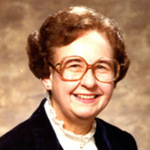
My name is Louis Marchiafava. Today's date is May 23, 2000. I am interviewing Renilda Hilkemeyer. This is for the M.D. Anderson Cancer Center Oral History Project.
Louis J. Marchiafava, PhD:
Ms. Hilkemeyer, I would like to begin the interview by obtaining some background information on you. Where were you born? Tell me something about your early education.
Renilda Hilkemeyer, RN, BS, Dr.P.H.:
I was born in the small town of Martinsburg, Missouri, about 150 miles west of St. Louis, Missouri. This is a Catholic community and a pretty rural community. My parents lived in town. We were right on the edge of town. I went to the Catholic school from the first grade to the tenth grade, and we did not have the last two years in that town. I wanted to finish to the twelfth grade, and my parents wanted me to, also. So, we had another Catholic school in another town about 17 miles in the other direction, and so my mother and I went to see the nuns one day to find out if it was possible for me to find a place that I could stay, because we didn't have money for room and board and school. And so, I wound up with a family that had two kids. Now, mind you, I was just out of the tenth grade but I ran the house, I did the shopping, I did the meals, I took care of the kids, I studied, and I was a straight A student.
Louis J. Marchiafava, PhD:
Did you have any particular interest in any subject?
Renilda Hilkemeyer, RN, BS, Dr.P.H.:
I was very good at math. I think one reason was I had a cousin who was a nun and she taught business arithmetic. And I had to take it because she was my cousin, whether I wanted to or not, in that school. I was interested in reading. I was interested in speaking. I was pretty good at both. And as a matter of fact, the family that I went to stay with, she got divorced and she worked at an ophthalmologist's office. And so, I used to go on Saturdays lots of times and help down in the office there along with all the rest of the stuff I was doing. And that doctor was really the one who sort of said to me, "What are you going to do when you get out of high school?" I didn't have any idea what I was going to do. He said, "I think you ought to think about nursing. You do a good job in that area."
We had relatives in St. Louis. My mother's brothers and sisters lived in St. Louis, and they said, well, she can come down and go to school here, or at least come down and see about it. So, we went down to see about it. I went to St. Mary's Hospital, to the diploma program which was a three year program, and stayed in the area there. And those were the days when we went to school with the medical students. If we worked all night, we went to school the next morning, four to six hours in school. We stayed up and did our school as well as the rest. Now, you can tell me to shut up whenever you want to.
Louis J. Marchiafava, PhD:
No, go on.
Renilda Hilkemeyer, RN, BS, Dr.P.H.:
And so, anyway, we went down and we looked at the school, and you didn't have a whole heck of a lot of money tied up because you worked for your rooming or board essentially as a student in those days. I had no trouble sleeping at night, so any time someone didn't show up for night duty, they usually called me and I got the night duty in addition to it. And I didn't really mind.
Renilda Hilkemeyer, RN, BS, Dr.P.H.:
So, when I got finished with the nursing program --three years, most of what women were doing at that time was private duty. I did a couple and I thought, that is for the birds! I didn't care for that at all. And so, I didn't exactly know what I was going to do but I thought, well, I would probably stay in the St. Louis area. One morning, I had a call to come down to the administrator's office. I got down and she said, "Oh Renilda, I understand you love surgery." I said, "I do?" I had probably two days there when I was a student and that was about it. "Well, we need a nurse in our hospital in Jefferson City," which was only about 100 miles away. And it was closer to my home because it was about 60 miles from where I lived. So, I really wasn't happy doing private duty and I thought, you know, I might as well go. So, I got down there and I "had room and board" and I made $50 a month. Big deal! And this was like a little room about this big and about four of us in the room. That was it.
The first morning I arrived on duty, the nun who was in charge of the operating room said, "Do you see those cases for today? Go get your instruments and get ready and be ready to scrub." And I said, "What do you mean, get your instruments? I don't know one instrument from another!" So, she said, "Well, I'll put you with" [Dr. So and So], at which point, she took me into the room and she said, "You've got a dumb one this morning, so you might as well be prepared." And so, anyway, that nun became a very good friend of mine. She and her three sisters were all in the same order, but she stayed down there. And even after I left there, I used to keep up with her and visit her when she was sick and all the rest of it. So, those are two things right off: how I came into being in St. Louis and how I got into nursing.
Louis J. Marchiafava, PhD:
What did you find about nursing that attracted you so much at such an early age?
Renilda Hilkemeyer, RN, BS, Dr.P.H.:
Well, first of all, there wasn't very much you could do. I was not interested in getting married. I wasn't interested in that process. You did that or you worked in somebody's house, and I had already done the working when I was in school. I didn't really care about that. And so, I liked people very much and I was used to people because in a small German community, we had 5,000 population, and people visited back and forth. And, you know, if I went over to your house, I would have something to eat, or you would come to my house and we would always have something to eat, something like that. So, I think probably that
was one thing. And I was interested in things that were new and different also. I liked things like that.
So anyway, I met a man who worked at the Health Department. He wasn't at the Health Department but he had a friend who was the Director of the Bureau of the Visitor Division of Health. And he was a friend of mine.
He said, "There is going to be some money coming in to the state for nursing. I have already told them to put your name on the list. Whether you want to or not, I've got your name on the list." Well, that meant that the government wanted to start teaching public health nursing to nurses, and you could go to school for one semester, either the University of Minnesota or George Peabody College for teachers in Nashville, Tennessee. And I went to Nashville because I knew it was cold in Minnesota and I didn't care much about going up there. I figured I had all the cold I needed.
I went and did my semester down there, and the people that taught the public health nursing courses were good. The one person was a very good leader. I had to do city public health, and I had to go to a real community for two months and do real public health as well. And she said to me, "You always seem to find out something to do." And I said, "Well, I can do that pretty well," and I did do it pretty well. But anyway, when I got finished with going to school and came back, I decided that I would try public health. And I had already been offered a job because the health department had the programs. And so, I did district public health nursing. I had 30 counties, if you can believe that. And don't ask me what I did. I did a little bit of this and a little bit of that and a little bit of everything else, and I did kind of interesting things. Some days, I would run the immunization clinic. I may have 600 kids I would have to set up for it --take care of them, give them their shots and stuff. Maybe the next day, I was over to school and we had gotten some food from the federal government and they didn't know what to do with it, so I went over and helped plan menus and set the food up. And they were so impressed; they sent somebody from Washington down to see our program because they had not heard of anything like that before. Well, I hadn't either but we did it. So that is what I was doing.
And then, I got sick and I developed pleurisy and pneumonia, and wound up with tuberculosis. And I think it is interesting, in this book and in that article, both of these that I was showing you, and the one I just put in here for you, too, this lady that wrote that book, I knew her, and her sister was a patient of ours down here. And she said, "Renilda, on your CV, you've got some years that don't add up for any nursing." I said, "No, they don't add up for any nursing. I was in the sanatorium. I was sick for several years." And she said, "Is it all right to put that in?" And I said, "As far as I am concerned, it is all right. Maybe somebody who doesn't have the courage to go do anything might figure out if it is not too bad, that they might be able
to do it, too," because in those days, I couldn't have anything except bed rest. So, I was flat on my back for two years.
Louis J. Marchiafava, PhD:
What years were these?
Renilda Hilkemeyer, RN, BS, Dr.P.H.:
The early 1940s. We had rest, bed rest. And I had had the fluid and they couldn't get the needle in between my pleura to give me the air. So then, they started talking about cutting my ribs and collapsing my lung and I didn't like that either. So, I remembered a doctor in St. Louis that was, when I was going to school in the nursing school, a good chest man. And I called him. I said, "If I come down, will you see me?" So, he came down. I went down. And I told him, I said, "I am not going to have my ribs cut and I am not going to lose my lung. I am just not going to do it. And besides that, I want to go to school. I can't work until I get over this. I can't work." So anyhow, he wrote me a letter and said, "Well, I am starting a new program. Do you want to try it?" said, "Well, tell me what it is." Well, what it was, was a way of giving air, not through your lungs but giving it in your peritoneum and filling you up like you were a football with air, and pushing your diaphragm up so it had to rest your diaphragm. And I got to school with that, and I got to Peabody and they wouldn't keep me. They told me I couldn't stay. They were not going to be responsible for anybody running around on campus like that. I said, "Well, here I am. He says I can come." Well, I had to get another doctor down there. That was fun. I went through all this Mickey Mouse until I got finished. Then I went to school and I got my bachelor's down there, so I got done with that project. So, I don't mind that .... as a matter of fact, several people have commented about the article that was in the journal. 'I didn't know you had TB.' I said, "Well, why should I tell you? You don't need to know I have it. I have it and that's it." So, I am over it. And when I came to this hospital, I had to get a statement from two doctors in Missouri before they would ever let me pass the health here in personnel because they weren't used to that either.
Renilda Hilkemeyer, RN, BS, Dr.P.H.:
So anyway, that is basically when I started out. I started out and I worked with the district public health. One of the questions I had to answer the first day I went to apply for the job was, do you have a car? No, but I can get one. Do you know how to drive? Yes. I didn't know the first thing about driving! So, this fellow that got me the job, I called him and I said, "You'd better be available on such and such a morning because I am going to come from my hometown. I am not stopping until I hit Jefferson City, and you'd better be there to get me up and down the hills because I have to be able to go over to the next town or Kent State. So, I finally did learn to drive. It was a chore. But nobody told me about how to wade the creeks. And nobody told me how to get through snowdrifts. I had that all to learn, which was quite a chore, I don't mind telling you.
I did that for three years. And then, I went to… well, the person who was the president of the state Nurse's Association was looking for somebody for her hospital, nursing school. And so, I went there as an assistant director for several years, and I stayed there. And I had all of that plus the clinic plus the student health service and whatever else you could think about. We didn't have any easy jobs. If you got off a half
day a month, you were doing exceedingly well because they didn't believe in it and they didn't pay you for it either.
Recommended Citation
Hilkemeyer, Renilda RN, BS, Dr.P.H. and Marchiafava, Louis J. PhD, "Chapter 01: A Track to Nursing Education" (2000). Interview Chapters. 1595.
https://openworks.mdanderson.org/mchv_interviewchapters/1595
Conditions Governing Access
Open
Accessibility Statement
This item was created prior to May 2026. It is preserved for research, reference, or historical recordkeeping. Following WCAG 2.1, the library may provide accessible versions of archival materials upon request. For accommodation requests please submit an accessibility request form.