
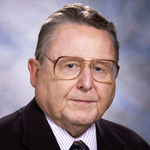
Gerald P. Bodey MD, Oral History Interview, June 26, 2013
Files
Download Interview Transcript (Text File) (54 KB)
Loading...
Description
Major Topics Covered:
- Research: bacterial and fungal infectious diseases and leukemia; chemotherapy and anti-bacterial/anti-fungal agents; laminar air-flow and infection control
- Changes in patient care
- The Office of Research Protocol: history, directing
- The Department of Medical Specialties
Interview Chapters
Identifier
DoddGP_02_20130625
Publication Date
6-26-2013
Publisher
The Making Cancer History® Voices Oral History Collection, The University of Texas MD Anderson Cancer Center
Creative Commons License

This work is licensed under a Creative Commons Attribution-Noncommercial-No Derivative Works 3.0 License.
Topics Covered
University of Texas MD Anderson Cancer Center; UT MD Anderson Cancer Center; University of Texas System. M.D. Anderson Cancer Center; M.D. Anderson Hospital and Tumor Institute at Houston; University of Texas M.D. Anderson Cancer Center; M.D. Anderson Hospital and Tumor Institute
Disciplines
History of Science, Technology, and Medicine | Oncology | Oral History
Recommended Citation
Bodey, Gerald P. MD and Rosolowski, Tacey A. PhD, "Gerald P. Bodey MD, Oral History Interview, June 26, 2013" (2013). Interview Sessions. 233.
https://openworks.mdanderson.org/mchv_interviewsessions/233
Conditions Governing Access
Redacted
Accessibility Statement
This item was created prior to May 2026. It is preserved for research, reference, or historical recordkeeping. Following WCAG 2.1, the library may provide accessible versions of archival materials upon request. For accommodation requests please submit an accessibility request form.


About the Interview
About the Interview Subject:
Gerald P. Bodey, M.D. (b. 22 May 1934, Hazleton, Pennsylvania) came to MD Anderson in 1966 as an Associate Professor of Medicine (and Associate Internist) in the Department of Developmental Therapeutics. He served as Chief of the Section of Infectious Diseases (1975 – 1995) and, Chief of Chemotherapy in the Department of Developmental Therapeutics (1975 – 1983). He is known for his work in specialist in infectious diseases. Early in his career he published Quantitative Relationships between Circulating Leukocytes and Infection in Patients with Acute Leukemia –described as a “citation classic” and one of the three most important papers on infectious diseases. This established the direction of his research: in collaboration with Dr. Emil J Freireich, he established MD Anderson as a major U.S. leukemia center and studied the effect of virtually every antibiotic and antifungal agent on leukemia patients. In 1977, directed the construction of twenty laminar air-flow patient units on the top floor of the Lutheran Pavilion –the first units ever to be built into a medical installation (rather than added on).
Dr. Bodey served as Chair of the Department of Medical Specialties from 1987 to his retirement 1995. He also served as Chief of the Section of Infectious Diseases in the Department of Infectious Diseases, Infection Control, and Employee Health. He is now an emeritus professor of medicine.
Original Interview Profile #39: Gerald Paul Bodey, Sr, M.D.
Submitted by: Tacey A. Rosolowski, Ph.D.
Date revised: 11 July 2014
This interview with Gerald P. Bodey, M.D. (b. 22 May 1934, Hazleton, Pennsylvania) takes place in X interview sessions in summer of 2013 (approximately 4:50 total duration). Dr. Bodey is well-known specialist in infectious diseases. In 1977, he also directed the construction of twenty laminar air-flow patient units on the top floor of the Lutheran Pavilion –the first units ever to be built into a medical installation (rather than added on).
Dr. Bodey came to MD Anderson in 1966 as an Associate Professor of Medicine (and Associate Internist) in the Department of Developmental Therapeutics. In 1995 he retired as Chair of the Department of Medical Specialties. He also served as Chief of the Section of Infectious Diseases in the Department of Infectious Diseases, Infection Control, and Employee Health. He is now an emeritus professor of medicine. The sessions take place at Dr. Bodey’s home in the Woodlands near Houston, Texas. Tacey A. Rosolowski, Ph.D. is the interviewer.
Dr. Bodey received his A.B. in 1956 from Lafayette College in Easton, Pennsylvania and went on to receive his M.D. in 1960 from Johns Hopkins Medical School. He undertook his internship and residency at the Osler Medical Service, Johns Hopkins Hospital (1960 – 1961, 1961 – 1962) before serving as a Clinical Associate at the NCI in Bethesda, Maryland (1962 – 1965). Dr. Bodey undertook another residency at the University of Washington, Seattle (1965 – 1966) before coming to MD Anderson to serve as Chief of the Section of Infectious Diseases (1975 – 1995) and, Chief of Chemotherapy in the Department of Developmental Therapeutics (1975 – 1983). He served as Medical Director of the Clinical Research Center in Lutheran Pavilion, overseeing the Laminar Air Flow Protective Environments (1977 – 1981). He then set up the Office of Research Protocol and served as its first Director (1981 – 1983). From 1987 until his retirement in 1995 Dr. Bodey served as Chair of the Department of Medical Specialties.
While working at the NCI, Dr. Bodey published Quantitative Relationships between Circulating Leukocytes and Infection in Patients with Acute Leukemia –described as a “citation classic” and one of the three most important papers on infectious diseases. This established the direction of his research, and he went on to author or co-author 1100 publications. He helped Dr. Emil J Freireich establish MD Anderson as a major U.S. leukemia center and studied the effect of virtually every antibiotic and antifungal agent on leukemia patients. His evaluative protocols are still in use, as is the robust research program and consultative service he helped to establish. Dr. Body also contributed to the development of chemotherapy programs and was responsible for developing MD Anderson’s laminar flow units in the Lutheran Pavilion, running many research projects to quantify the effect of these protected environments on leukemia patients, with implications for all cancer patients. In 1990 Dr. Bodey was listed as one of the 300 “most-cited authors in the scientific literature by the Institute for Scientific Information. Three MD Anderson awards were named for Dr. Bodey: the Gerald P. Bodey Immunocompromised Host Fellowship Training Program from the Department of Infectious Diseases, Infection Control, and Employee Health the Gerald P. Bodey, Sr. Distinguished Professorship and the Gerald P. Bodey Award for Excellence in Education from the Division of Medical Oncology.
In this interview Dr. Bodey discusses the breadth of his work on infectious diseases in leukemia patients, contextualizing his pioneering work in the medical approaches of the early sixties. He covers his studies of antibiotic and antifungal agents, as well as his work with the laminar air flow units. He speaks about the dramatic changes that his work made in patient care and comments on changes in researchers’ relationships with pharmaceutical companies. Dr. Bodey offers his views of mentor and friend, Dr. Emil J Freireich, and Dr. R. Lee Clark, and he comments on the role of his own faith in his career.