If you have any questions about uploading your poster or signing the agreement, contact the Research Medical Library.
-
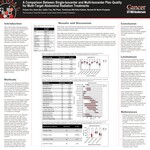
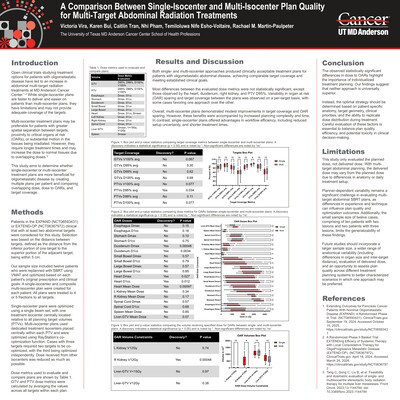
A Comparison Between Single-Isocenter and Multi-Isocenter Plan Quality for Multi-Target Abdominal Radiation Treatments
Victoria Vira, Karen Bui, Caitlin Tran, Nhi Pham, Temiloluwa Oluwanifemi Esho, and Rachael M. Martin-Paulpeter
Comparison of single- versus multi-isocenter SBRT VMAT plans for abdominal oligometastases showed both are clinically acceptable. Multi-isocenter offered slight improvements but greater complexity.
-
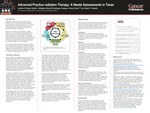
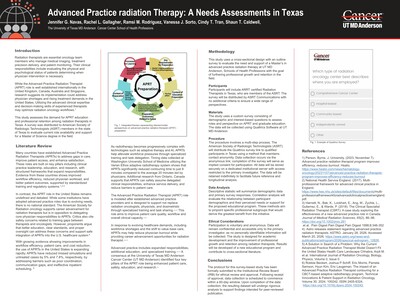
Advanced Practice Radiation Therapy: A Needs Assessment in Texas
Jennifer Navas, Vanessa Sorto, Cindy Tran, Rachel Gallagher, and Ramsi Rodriguez
-
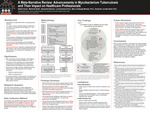
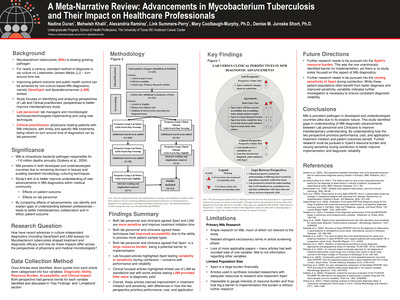
A Meta-Narrative Review: Advancements in Mycobacterium Tuberculosis and Their Impact on Healthcare Professionals
Nadine Duran, Mehwish Khalil, Alexandria Ramirez, Link Summers-Perry, Mary Coolbaugh-Murphy, and Denise Juroske Short
-
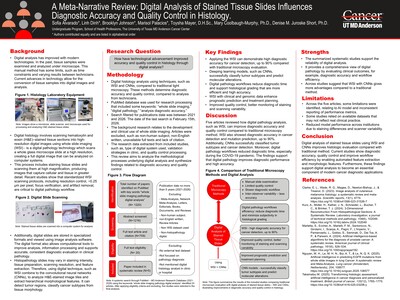
A Meta-Narrative Review: Digital Analysis of Stained Tissue Slides Influences Diagnostic Accuracy and Quality Control in Histology
Sofia A. Alvarado, Linh N. Dinh, Brooklyn S. Johnson, and Marisol Palacios
-
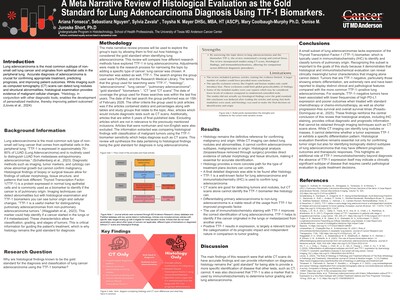
A Meta-Narrative Review of Histological Evaluation as the Gold Standard for Lung Adenocarcinoma Diagnosis Using TTF-1 Biomarkers
Sebastianz P. Nguyen, Ariana C. Fonseca, and Sylvia Zavala Rideaux
-
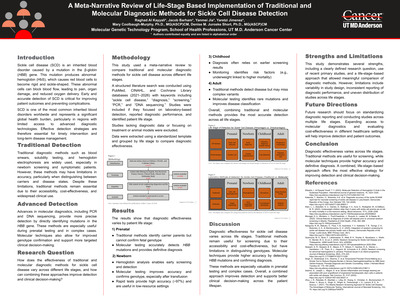
A Meta-Narrative Review of Life-Stage Based Implementation of Traditional and Molecular Diagnostic Methods for Sickle Cell Disease Detection
Raghad Al Kayyali, Jacob Barham, Yanmei Jia, and Yaretzi Lucero Jimenez
-

Artificial Intelligence For Automated CT Quality Assurance: Improving Accuracy, Efficiency, and Standardization
Angelina Garcia, Francisco Parada, Shannell Rojas, Lizzette Serrano, and Vanessa Vanegas
-
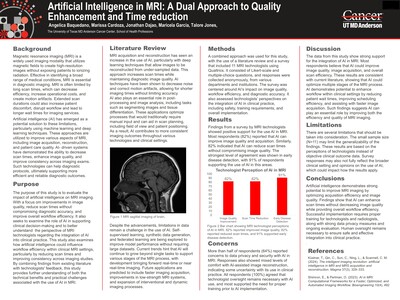
Artificial Intelligence in MRI: A dual Approach to Quality Enhancement and Time Reduction
Angelica Maria Baquedano, Marissa Elizabeth Cardoza, Jonathon H. Dajao, Maricela Garcia, Talore Lanice Jones, and Saleha Zafar
-
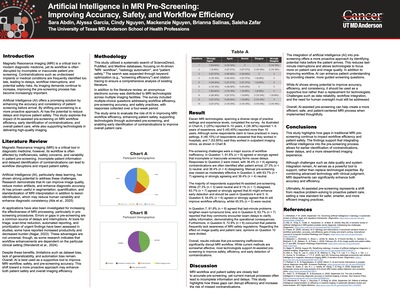
Artificial Intelligence in MRI Pre-Screening: Improving Accuracy, Safety, and Workflow Efficiency
Sara Abdin, Alyssa Sophia Garcia, Cindy Nguyen, Mackenzie Nguyen, Brianna Salinas, and Saleha Zafar
-
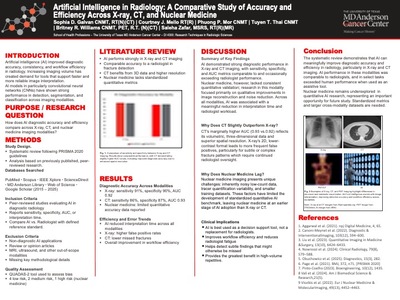
Artificial Intelligence in Radiology: A Comparative Study of Accuracy and Efficiency Across X-ray, CT, and Nuclear Medicine
Courtney J. Mello, Sophia D. Galvan, Britney R. Williams, Tuyen T. Thai, Phuong P. Mor, and Saleha Zafar
Artificial intelligence (AI) is increasingly used in radiology to improve diagnostic accuracy and workflow efficiency; however, there is limited standardized research comparing its performance across imaging modalities. This study aimed to evaluate the accuracy and efficiency of AI in X-ray, computed tomography (CT), and nuclear medicine. A systematic review was conducted following PRISMA guidelines, analyzing peer-reviewed studies published between 2015 and 2025. Data were extracted on key performance metrics, including sensitivity, specificity, interpretation time, and error rates, to enable cross-modality comparison. Results demonstrated that AI achieved high diagnostic accuracy in X-ray imaging, with average sensitivity and specificity near 91% and 90%, respectively, though it still had limitations in detecting subtle findings. In CT imaging, AI showed comparable specificity and slightly lower sensitivity while improving the detection of volumetric data and lesions. Nuclear medicine applications primarily demonstrated qualitative benefits, including improved image reconstruction and noise reduction, but lacked standardized quantitative metrics for direct comparison. Across modalities, AI consistently reduced interpretation time and improved workflow efficiency, although variability in study design limited full comparability. Overall, AI serves as an effective clinical decision-support tool that enhances radiologist performance rather than replacing it, highlighting the need for standardized evaluation frameworks and expanded research in nuclear medicine.
-
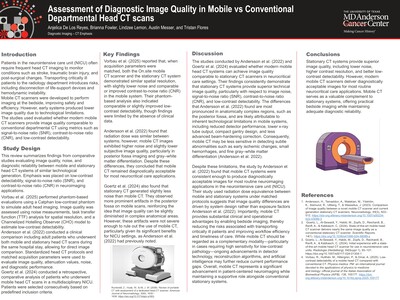
Assessment of Diagnostic Image Quality in Mobile vs Conventional Departmental Head CT scans
Anjelica De Los Reyes, Austin Messer, Brianna Fowler, Tristan Flores, Lindzee Lemonn, and Saleha Zafar
-
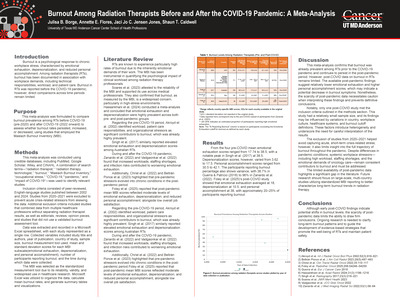
Burnout Among Radiation Therapists Before and After the Covid-19 Pandemic: A Meta-Analysis
Julisa B. Borge, Annette E. Flores, Jaci Jo C. Jensen-Jones, and Shaun T. Caldwell
-
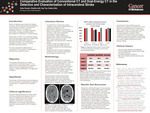
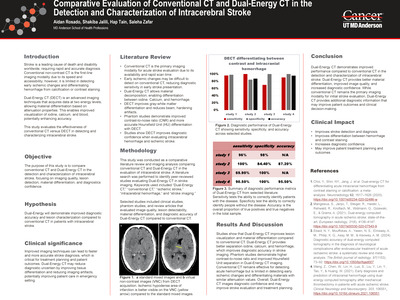
Comparative Evaluation of Conventional CT and Dual-Energy CT in the Detection and Characterization of Intracerebral Stroke
Aidan Rosado, Shakiba Jalili, Hap Tain, and Saleha Zafar
-
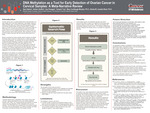
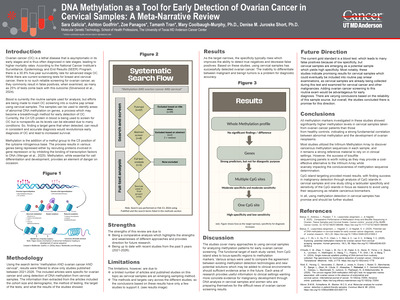
DNA Methylation as a Tool for Early Detection of Ovarian Cancer in Cervical Samples: A Meta-Narrative Review
Sara Galicia, Ashton Godfrin, Zoe Panagos, and Tamanh Tran
-
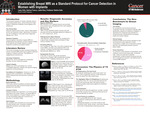
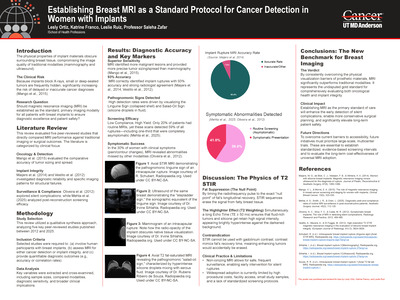
Establishing Breast MRI as a Standard Protocol for Cancer Detection in Women with Implants
Leslie Estela Ruiz, Katrine Gisell Franco, and Lesly Karina Ortiz
Breast implants can limit the effectiveness of traditional imaging methods like mammography and ultrasound by obscuring underlying tissue and masking abnormalities. This literature review highlights findings from six studies demonstrating that magnetic resonance imaging (MRI) provides superior accuracy in both cancer detection and implant evaluation. MRI consistently shows higher sensitivity and specificity, effectively identifying tumors, assessing their size and spread, and detecting implant ruptures with strong agreement to surgical outcomes. It also enables long-term monitoring by revealing silent complications and improving screening compliance in post-reconstruction patients. Overall, MRI offers enhanced tissue contrast and three-dimensional visualization, making it the most reliable modality for evaluating breast health in women with implants. While not a complete replacement for conventional methods, it serves as the gold standard for specific indications and plays a critical role in a comprehensive, multimodal imaging strategy.
-
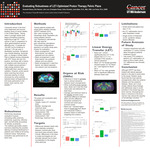
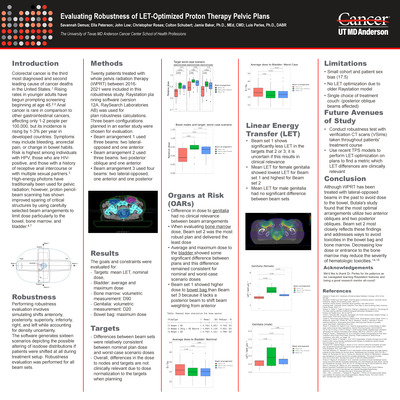
Evaluating Robustness of LET-Optimized Proton Therapy Pelvic Plans
Savannah Demus, Christopher Rosas, Colton Schubert, Ella Peterson, John Low, Jamie Baker, and Luis Perles
Assessing robustness of linear energy transfer (LET)-optimized pencil beam scanning (PBS) proton therapy plans for whole pelvis irradiation treatment (WPRT) of anal cancer.
-

Exploring the Drivers of Excessive CT Ordering in the Emergency Department. A Mixed Methods Study of Provider Decision Making, Workflow Pressures, and System-Level Factors Contributing to Unnecessary Imaging
Anabel Battenfield, Sandra Escobar, Enrique Salazar, and Saleha Zafar
CT overutilization emergency department
-
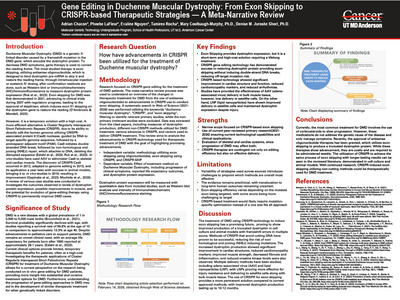
Gene Editing in Duchene Muscular Dystrophy: From Exon Skipping to CRISPR-based Therapeutic Strategies - A Meta-Narrative Review
Adrian Chacon, Phoebe LaFleur, Evaline Nguyen, and Tamires Rocha
-
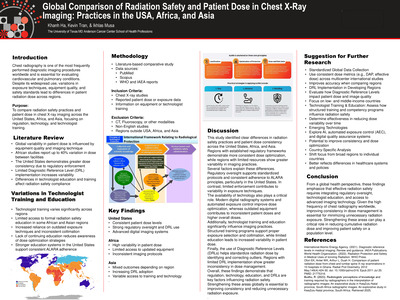
Global Comparison of Radiation Safety and Patient Dose in Chest X-Ray Imaging: Practices in the USA, Africa, and Asia
Khanh L. Ha, Kevin Tran, and Ikhlas Musa
-
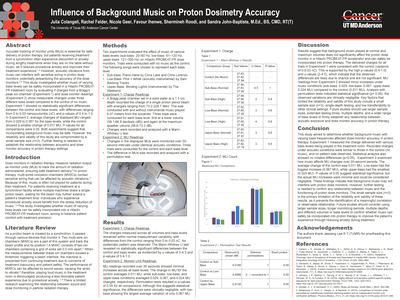
Influence of Background Music on Proton Dose Monitors
Julia Colangeli, Rachel Felder, Nicole Geer, Favour Ihenwe, Shermineh Roodi, and Sandra John Baptiste
This study examines the effects of background music, particularly varying bass frequencies, on dose monitor accuracy in proton therapy using the Hitachi PROBEAT-FR proton accelerator.
-
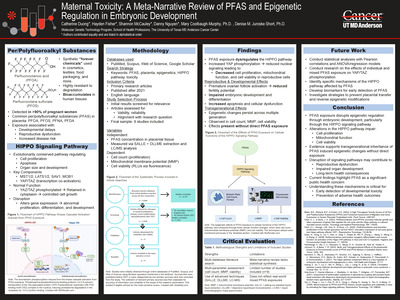
Maternal Toxicity: A Meta-Narrative Review of PFAS and Epigenetic Regulation in Embryonic Development
Catherine Duong, Hayden J. Fisher, Shannon McCauley, and Danny M. Nguyen
-
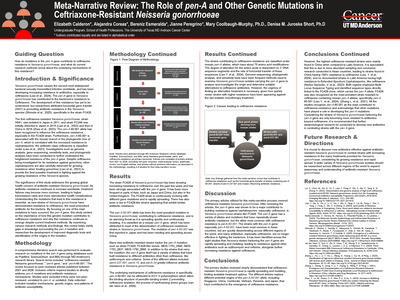
Meta-Narrative Review: The Role of pen-A and Other Genetic Mutations in Ceftriaxone-Resistant Neisseria gonorrhoeae
Elizabeth Calderon, Alejandra D. Coreas, Bereniz A. Esmeralda, Jianne A. Peregrino, Denise M. Jursoke Short, and Mary Coolbaugh-Murph
-
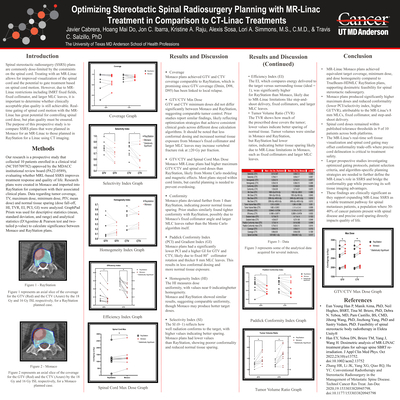
Optimizing Stereotactic Spinal Radiosurgery with MR-Linac Treatment in Comparison to CT-Linac Treatments
Kristine Raju, Javier Cabrera, Jon Ibarra, Alexis Sosa, Hoang Mai Do, Travis Salzillo, and Lori Simmons
-
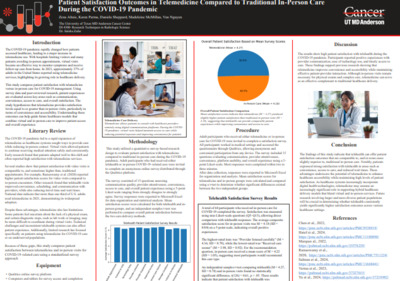
Patient Satisfaction Outcomes in Telemedicine Compared to Traditional In-Person Care During the COVID-19 Pandemic
Daniela Sheppard, Karen A. Parma, Zena Altaie, Madeline P. McMillan, and Van Nguyen
-
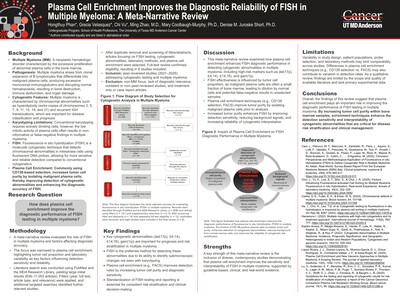
Plasma Cell Enrichment Improves the Diagnostic Reliability of FISH in Multiple Myeloma: A Meta-Narrative Review
Chi Ngoc Vu, Hongthuy Phan, and Grecia Velasquez