
Students Summer in Oncology at Anderson Research (SOAR) 2026
 

Files

Download Available for download on Saturday, July 24, 2027

View Poster (1.5 MB)

Description

Introduction: 

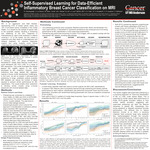
Inflammatory breast cancer is an aggressive and fatal disease, representing 2-4% of breast cancer cases and 10% of all breast cancer mortalities in the United States. We previously developed a DenseNet121 based deep-learning model distinguishing IBC from LABC across MRI sequences, trained on the largest labeled IBC mpMRI registry (MD Anderson). However, many institutions lack IBC registries for in-house model development. In this work, we aim to assess if self-supervised pretraining on large, unlabeled, publicly available MRI datasets can reduce the number of labels required to achieve similar performance for IBC classification. 

Methods: 

For our pretraining protocol, we compared two approaches: Bootstrap Your Own Latent and Masked Autoencoder, trained exclusively on DCE and T2 Water Dixon MRI sequences from The Cancer Imaging Archive. Each encoder was evaluated at varying labeled-data fractions from the MD Anderson registry. Both frozen and fine-tuned parameters were assessed.  

Results: 

Both BYOL pretraining regimens outperformed non-pretrained with frozen parameters for both DCE (0.78 vs 0.64) and T2 (0.78 vs 0.73) at 100% labels, indicating BYOL’s self-supervised pretraining learned rich representations of IBC features. For fine-tuned single-sequence runs (DCE, T2), from-scratch matched or exceeded all pretraining protocols across label fractions. Notably, frozen BYOL outperformed fine-tuned BYOL at low label fractions (e.g., T2: 0.72 vs 0.57 @ 30% labels), indicating fine-tuning degraded pretrained representations. At 30% labels, frozen BYOL performance matched fine-tuned scratch performance for both DCE (0.69 vs 0.66) and T2 (0.72 vs 0.75), suggesting pretraining could help with an improved fine-tuning regimen. MAE performance was worse than BYOL pretraining and scratch under both frozen and fine-tuned experiments, suggesting MAE learned features are poor. 

Conclusion:   

The results suggest self-supervised pretraining is a promising approach for improving classification of IBC vs LABC under sparse labels.

Program Affiliation

Medical Students Summer in Oncology at Anderson Research (SOAR) Program

Publication Date

7-23-2026

Self-Supervised Learning for Data-Efficient Inflammatory Breast Cancer Classification on MRI

Share

COinS
 

Accessibility Statement

This item was created prior to May 2026. It is preserved for research, reference, or historical recordkeeping. Following WCAG 2.1, the library may provide accessible versions of archival materials upon request. For accommodation requests please submit an accessibility request form.